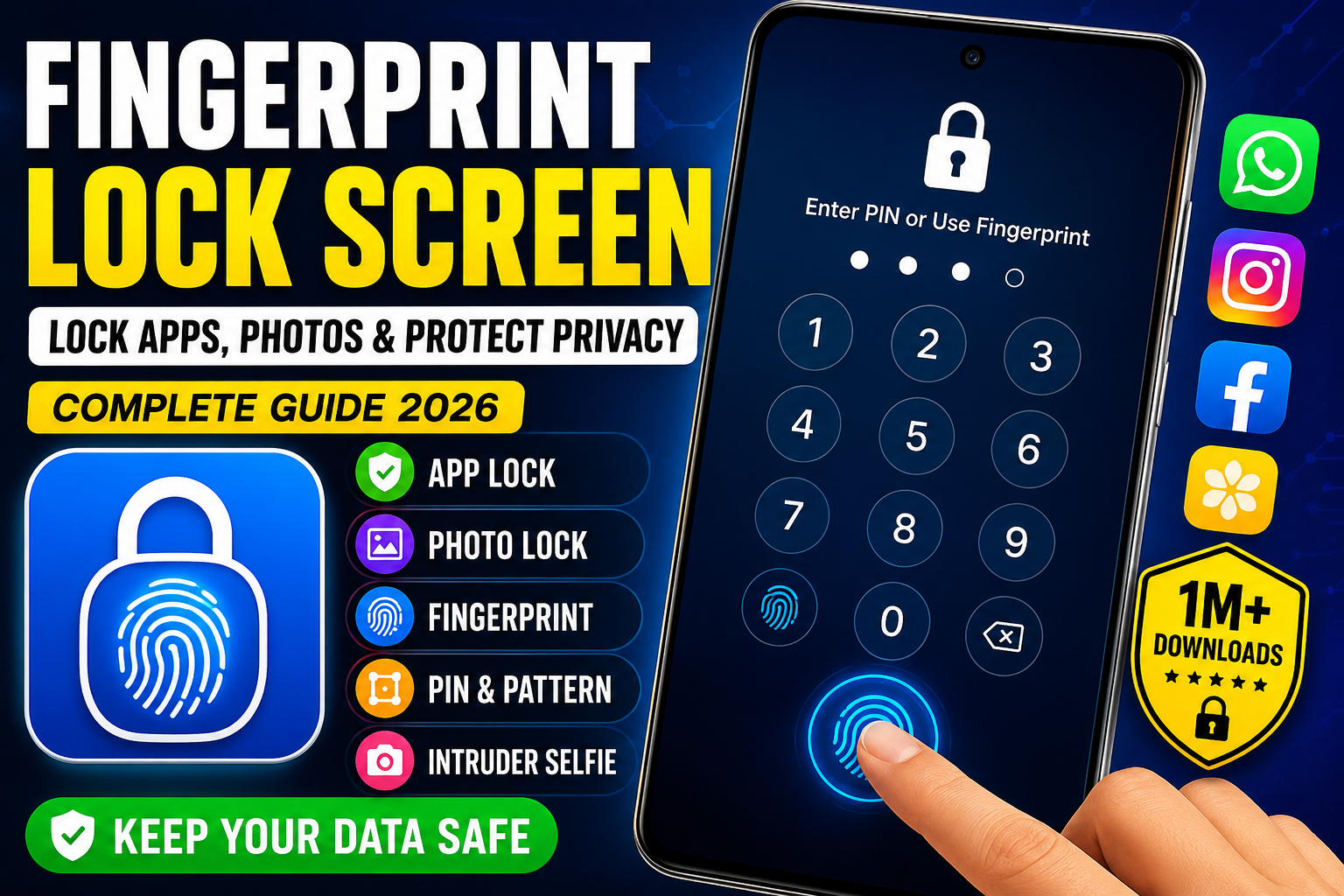
The problem is that unlocking your phone does not necessarily mean you want everyone to have access to every app, photo, video, or personal file stored on it.
This is where an app locker can be useful.
Fingerprint Lock Screen is an Android privacy-focused application designed to add another layer of protection to apps and personal content. The app is listed on Google Play under DOSA Apps and currently has more than 1 million downloads. Its Play Store listing also shows a 4.2-star rating from around 15,000 reviews.
The app focuses on features such as app locking, fingerprint-style protection, PIN and pattern options, photo protection, and additional privacy tools.
But is it actually useful? How does it work? What should you know before installing it?
Let’s take a closer look.
What Is Fingerprint Lock Screen?
Fingerprint Lock Screen is an Android security and privacy application designed to help users restrict access to selected apps and personal content.
The basic idea is simple.
Your phone already has a lock screen, but once you unlock the device, most applications become accessible. An app-locking tool can add another security step before selected applications can be opened.
For example, imagine that your phone is unlocked and you hand it to someone so they can make a call. Without additional protection, that person could potentially open your Gallery, WhatsApp, Instagram, file manager, or another application.
With an app locker, you can protect selected apps separately.
The Google Play listing describes Fingerprint Lock Screen as an app and gallery locker designed to protect applications and hide photos. It also lists PIN, pattern, fingerprint-related protection, voice lock and an intruder selfie feature among its tools.
Why Would You Need an App Locker?
Most people don’t think about app privacy until they actually need it.
You may have nothing to hide, but privacy is not the same thing as hiding something wrong.
Your phone can contain private conversations, personal photographs, work documents, banking applications, saved files and other information that you simply don’t want other people opening.
A normal Android screen lock protects the entire device. An app locker can provide an additional layer for selected applications after the phone itself has already been unlocked.
This can be especially useful in situations such as:
- Giving your phone to children
- Lending your phone to a friend
- Keeping personal photos private
- Protecting messaging applications
- Preventing accidental changes to important apps
- Restricting access to selected applications
- Adding an extra privacy layer to your phone
The goal isn’t to make your phone completely invisible or impossible to access. Instead, it gives you more control over which apps require additional authentication.
Key Features of Fingerprint Lock Screen
The application includes several features aimed at improving privacy on Android devices.
1. App Lock
The main purpose of the app is to protect selected applications.
Instead of locking the entire phone, you can use an app locker to create an additional barrier around specific apps.
For instance, you might want to protect:
- Gallery
- File manager
- Email apps
- Notes
- Other personal applications
The advantage is flexibility. You don’t necessarily have to lock every application on your phone.
If someone needs to use your calculator or browser, there may be no reason to make them enter another password. But private applications can receive additional protection.
2. Fingerprint Protection
Fingerprint-based authentication is one of the main ideas behind the app.
Modern Android phones commonly include fingerprint sensors, although the exact hardware and Android implementation differs between manufacturers.
When supported by the device and app, biometric authentication can make unlocking more convenient because you don’t have to type a password every time.
However, don’t assume that every phone will provide exactly the same fingerprint experience. Android versions, manufacturer software and device security systems can affect how third-party app lockers work.
3. PIN Lock
Some users prefer a traditional PIN instead of biometric authentication.
A PIN can be useful when:
- Your phone’s fingerprint sensor isn’t working properly
- You prefer not to use biometrics
- Your device doesn’t support fingerprint authentication
- You want a backup authentication method
Having an alternative method can make an app locker more practical for everyday use.
4. Pattern Lock
Pattern-based security is another familiar option for Android users.
Instead of entering numbers, you connect points on the screen to create a pattern.
Patterns can be quick to enter, although you should choose one that isn’t easy for another person to guess by watching you unlock your phone.
5. Photo and Gallery Protection
Photos are often one of the main reasons people look for privacy applications.
Your Gallery may contain family photographs, screenshots, documents, personal memories or other images that you don’t want someone casually browsing.
The Google Play listing specifically describes the app as an app and gallery locker for protecting photos.
If you use a feature that hides or protects media, make sure you understand where the files are stored and how the recovery process works before moving important photographs.
Never rely on a privacy app as your only backup for important files.
6. Intruder Selfie
Another feature mentioned by the app is an intruder selfie function.
The basic idea behind this type of feature is that the application can use the phone’s front camera to capture an image when someone attempts unauthorized access.
This can be useful if you frequently leave your phone somewhere and want to know whether someone tried to access protected content.
The availability and exact behavior of this feature may depend on device permissions and Android restrictions.
7. Voice Lock
The current Play Store description also mentions voice lock functionality.
Voice-based unlocking can sound interesting, but users should remember that voice authentication may not provide the same security level as a strong device passcode or modern biometric authentication.
If privacy is your priority, don’t treat a voice feature as a replacement for your phone’s primary security system.
How to Install Fingerprint Lock Screen
Installing the app is straightforward because it is available through Google Play.
The safest approach is to use the official Play Store listing rather than downloading an APK from an unknown website.
Open Fingerprint Lock Screen on Google Play
Open the listing, check the developer name, ratings, reviews and permissions, and then tap the install button.
The application is currently listed under DOSA Apps and is rated for users aged 3+.
How to Set Up an App Lock
After installation, the exact interface may vary depending on the current version of the application.
Generally, the setup process follows a simple pattern.
Step 1: Open the App
Launch Fingerprint Lock Screen after installation.
The first screen may guide you through the security setup process.
Step 2: Choose a Security Method
Depending on your device and the options available in the app, you may be able to choose between fingerprint, PIN, pattern or another supported method.
Choose the option you are most comfortable using.
Step 3: Give Required Permissions
Privacy and security applications may request permissions that are necessary for their features to work.
Read each permission carefully before accepting it.
Don’t automatically allow every permission without understanding why the app needs it.
Step 4: Select Apps
Look for the section where you can choose applications to protect.
Select only the apps that actually need an additional lock.
For most people, protecting a handful of sensitive apps is more convenient than locking everything.
Step 5: Test the Lock
After setting everything up, close one of the protected applications and open it again.
You should see the additional authentication screen.
Testing it immediately is important because it lets you discover compatibility issues before depending on the app for privacy.
Is Fingerprint Lock Screen Safe to Use?
This is one of the most important questions.
No third-party privacy application should automatically be considered completely secure just because it appears on Google Play.
The Play Store provides a Data Safety section, but the information shown there is developer-provided and can change over time.
For Fingerprint Lock Screen, Google Play currently indicates that the app may share device or other IDs with third parties. It also indicates encrypted data in transit and states that no data is collected under the developer’s declaration.
These details should be read before installation.
There is another important point: an app locker generally needs special access to monitor or protect other applications. Depending on the implementation, such permissions can be sensitive.
That doesn’t automatically mean the application is unsafe. It simply means users should understand what they are granting.
For a privacy-focused app, checking permissions is just as important as checking its feature list.
What Permissions Should You Pay Attention To?
When installing any app-locking application, don’t focus only on the number of stars.
Pay attention to permissions related to:
- Accessibility
- Usage access
- Notifications
- Camera
- Storage or photos
- Device administration
- Overlay permissions
Not every version or Android device will request all of these.
If a permission is required for a particular feature, the app should explain its purpose. If something doesn’t make sense, take a moment to investigate it before continuing.
Android also allows you to review permissions through system settings.
Fingerprint Lock Screen vs Android’s Built-In Security
Before installing a third-party app locker, check whether your phone already provides a similar feature.
Many modern Android manufacturers offer built-in privacy tools, secure folders, app locks or private spaces.
These system-level solutions can have an advantage because they are integrated directly into the operating system.
For example, some phones allow you to protect individual applications without installing another application.
So the question isn’t simply:
“Is Fingerprint Lock Screen good?”
A better question is:
“Does my phone already offer the feature I need?”
If your phone doesn’t have a suitable built-in app lock, a third-party solution can be useful.
Fingerprint Lock Screen Pros
There are several reasons someone might want to try the app.
Easy Concept
The idea is very straightforward. Choose an application and add another authentication step.
Multiple Security Options
The listing mentions fingerprint-related protection along with PIN and pattern options, giving users more than one way to secure access.
App and Photo Protection
The application focuses not only on apps but also on gallery and photo privacy.
Additional Privacy Features
Features such as intruder selfie and voice lock provide additional tools beyond a basic app lock.
Available Through Google Play
Using the official Play Store listing is preferable to downloading an unknown APK from random websites.
Fingerprint Lock Screen Cons
No privacy app is perfect.
One potential downside is that third-party app lockers can sometimes behave differently across Android devices.
Android manufacturers modify their software heavily, and battery optimization systems can stop background services from working correctly.
Another consideration is advertising and in-app purchases. Google Play currently lists Fingerprint Lock Screen as containing ads and in-app purchases.
Some users may also prefer built-in Android privacy features because they don’t require another application to remain active.
Finally, additional permissions can make some privacy-conscious users uncomfortable.
Does It Replace Your Phone’s Lock Screen?
No.
An app locker should be considered an additional privacy layer rather than a replacement for your phone’s main security system.
You should still use a strong screen lock.
A proper device PIN or password protects the phone before it is unlocked. The app locker is then an additional barrier for selected applications.
Think of it like having two doors instead of one.
The first door protects your phone.
The second door protects particularly private apps.
Can You Lock WhatsApp and Social Media Apps?
The app is designed to protect selected applications, so social media and messaging apps are among the types of applications users may want to protect.
The exact list depends on which apps are installed on your device and how the current version of Fingerprint Lock Screen works.
If you mainly want to protect WhatsApp, Instagram or your Gallery, select only those applications rather than unnecessarily locking everything.
This keeps the phone easier to use.
Can It Protect Banking Apps?
You can use an app locker as an additional privacy layer around sensitive applications, but it should never be considered a replacement for the security mechanisms provided by your banking application.
Banking apps usually have their own authentication, encryption and security systems.
Always keep your banking app updated and use its official security options.
If your bank supports biometric login, a strong device PIN and biometric authentication are generally preferable to relying entirely on a third-party app locker.
What Happens If You Forget the Password?
This is something you should think about before locking important applications or files.
Different app-locking applications provide different recovery methods.
Before moving sensitive photos or documents into any vault-style feature, check how password recovery works.
Don’t create a situation where important personal files are locked away and you don’t know how to recover them.
It is also a good idea to maintain a separate backup of important photographs and documents.
Should You Use Fingerprint Lock Screen in 2026?
It depends on your phone and your privacy needs.
If your Android device already has a reliable built-in app-locking or private-space feature, you may not need a separate application.
But if your phone doesn’t provide the functionality you want, Fingerprint Lock Screen can be worth considering.
The app currently has more than 1 million downloads and thousands of reviews on Google Play, showing that it has attracted a substantial user base.
However, popularity alone shouldn’t determine whether you install a security application.
Check permissions, read the Data Safety section, review recent feedback and test the features yourself.
My Take on Fingerprint Lock Screen
The biggest advantage of Fingerprint Lock Screen is its simple purpose: adding an extra privacy barrier to selected parts of your Android phone.
For someone who regularly lends their phone to friends or family, this can be convenient.
You don’t have to worry about someone casually opening your Gallery or scrolling through private applications after you have already unlocked the phone.
At the same time, I wouldn’t recommend treating any third-party app locker as a complete security solution.
Your phone’s built-in lock screen should remain the first line of defense.
For sensitive information, backups and official security features are also important.
Frequently Asked Questions
What is Fingerprint Lock Screen?
Fingerprint Lock Screen is an Android privacy application designed to protect selected apps and personal content using additional authentication methods.
Is Fingerprint Lock Screen available on Google Play?
Yes. The app is available through Google Play under the name Fingerprint Lock Screen and is published by DOSA Apps.
Is Fingerprint Lock Screen free?
The Google Play listing currently shows the application as containing ads and in-app purchases.
Can I use it to protect photos?
The app’s Play Store listing describes it as an app and gallery locker that can be used for photo privacy.
Does it support PIN and pattern protection?
The listing mentions PIN and pattern-based locking along with fingerprint-related protection.
Does it work on every Android phone?
The application is designed for Android, but specific features can vary depending on the Android version, manufacturer and available device permissions.
Should I uninstall my phone’s existing security tools?
No. A third-party app locker should generally be treated as an additional privacy tool, not a replacement for your phone’s built-in security.
Is it safe to download the APK from random websites?
For security reasons, it is better to use the official Google Play listing instead of downloading an APK from an unknown third-party website.
Final Thoughts
Privacy on a smartphone isn’t only about keeping the entire device locked. Sometimes you simply want certain apps, photographs or personal information to have an extra layer of protection.
That’s the main reason tools like Fingerprint Lock Screen can be useful.
The app provides several privacy-oriented features, including app locking, PIN and pattern options, fingerprint-related protection, gallery protection and additional tools such as intruder selfie and voice lock.
Still, it’s worth taking a few minutes to check your phone’s built-in privacy features first. If your device already offers a reliable app lock or private folder, that may be the simpler option.
If you decide to use Fingerprint Lock Scree
